An Hour of Painted Walls in Downtown Charleston
I live here, so this one cost me almost no road at all. Five miles of driving, a lot on the river end of downtown, and then an hour on my own two feet looking at walls I have walked past for years without stopping.
That is the honest reason I went. A mural is the easiest thing in a city to not see. It sits above eye level, it does not move, and it never asks you for anything, so your attention slides off it and onto the crosswalk light. I wanted to find out what an hour of deliberate looking would turn up in eight blocks I already know.
Nine walls, as it happened, and two more I could see well enough to know I was not seeing them properly. Here is the route, what is on them, and what the light did while I walked.
The route, in the order I walked it
I started near the boulevard end of Capitol Street at eight-oh-five and worked north, away from the river, on the east sidewalk. That side is in shade at that hour, which sounds backward, but shade is what you want when the wall you are looking at is in sun.
From there the shape of the walk is simple. Up Capitol to Quarrier, across to Summers, down Summers as far as Lee, into the alley that runs behind the Capitol Street fronts, back out to Hale, and then a long block back toward the boulevard to close the loop. One mile and seven tenths by the odometer on my watch, which is not much, though I stopped so often that it took an hour.
The footing is city sidewalk, in good repair on the main faces and patched in the alley, where the surface goes to old brick with a crown to it. Two curb ramps on the route are steep enough to notice. There is no stretch of it that requires anything but ordinary shoes.
The walls
I am not naming a single artist here, and I am not copying out the words that appear on two of these walls. The names are signed in the corners where they belong, and anyone standing in front of the wall can read them. What I can give you is what is painted.
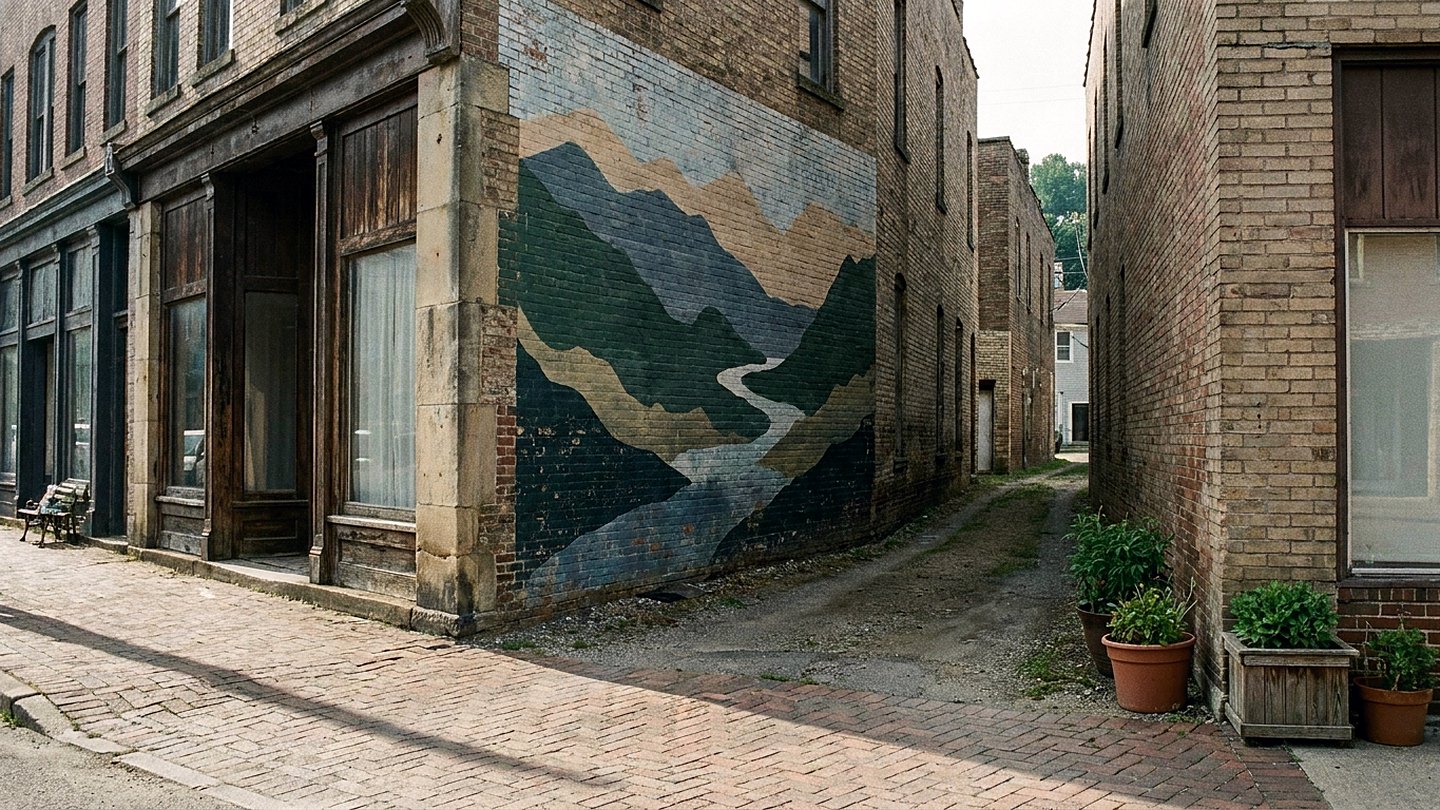
- A river bend rendered in flat bands, six or seven shades of blue gray and green, with the far bank simplified down to a single dark line. It covers three stories of brick on the alley side and it is the largest thing on the route.
- Ridgelines stacked in layers with fog between them, painted so the near ridge is nearly black and the far one nearly white. This is the one that stops me every time I go by.
- A heron standing in shallow water, twice life size, on a wall that used to be a doorway and still shows the outline of it under the paint.
- A field of marigolds and dark green leaves running the full length of a low wall, about eight feet high and forty long. It gets the earliest sun of anything on this route.
- Two hands holding open a paper sack of seed, with the seed painted mid-fall.
- A band of horizontal strata, tan over gray over black, that reads as a road cut if you look at it one way and as a piece of cloth if you look at it another.
- Sycamore leaves on a rolling door, which means the picture is only there when the door is down. It was down at eight-thirty and up when I came back through at nine.
- A fiddle and a pair of hands, no face, on a narrow wall about twelve feet wide.
- Geometric shapes in warm colors on a stair tower, visible from two blocks away and much clearer from across the street than from under it.
The two I could not judge were both partly blocked, one by a delivery vehicle parked tight against the curb and one by scaffolding. I will go back for those.
What the light did between eight and nine
This is the part I did not plan for and would now plan the whole walk around.
At eight-oh-five the sun was low and coming straight up the streets that run toward the river. That put the east faces in full light and the west faces in deep blue shade, and it made the alley a completely different room from the street it connects. In the alley the only light was bounced, and the colors on the big river wall went quiet and cool, more gray than green.
By eight-forty the sun had climbed enough to clear the roofline on the west side of Capitol Street, and a hard bright edge came down the ridgeline wall from the top. For about four minutes there were two paintings on that wall at once, a lit one above and a shaded one below, with a line between them moving slow enough to watch.
At nine the marigold wall was in full sun and had gone from a picture to something closer to a lamp. It was too bright to look at straight on. That wall wants an overcast day, or a late afternoon, and I would say the same for the geometric stair tower.
The plain lesson is that an hour earlier or two hours later gives you a different set of walls. None of these paintings are fixed things. They are surfaces that report whatever the sky is doing.
What took the time
Sixty-six minutes on foot, and it broke down about like this.
- Thirty-one minutes standing still in front of walls, which is where the hour really went.
- Twenty-two minutes walking between them at a slow pace, with two stops at crossings.
- Eight minutes in the alley, which is one long block and the quietest part of the loop.
- Five minutes doubling back for the rolling door, which I had missed on the first pass.
The route itself would take twenty-five minutes if you simply walked it. The other forty-one are the point.
What it came to
Five miles driven, sixty-six minutes and one mile seven tenths on foot, nine walls looked at properly and two put on the list for next time. I was back at my desk by half past nine with the whole workday intact.
It will not suit everybody. There is no shade to speak of on the main faces after nine in June, and the sidewalk holds heat. The alley section has brick with a crown to it and a couple of soft spots, so a walker or a stroller belongs on the street faces instead. Downtown traffic starts in earnest around eight-thirty, and the crossings on the wider streets are not quick. And if you want the walls in even light, take an overcast morning instead of a clear one, which is the reverse of what most people would guess.
What I got for the hour was a downtown I had been driving through and had not actually looked at since I was in my twenties. For five miles of road, I will take that trade.
The count
- Time on site 66 minutes
- Walking 1.7 miles at a slow pace
- Walls counted nine, plus two I could not see well
Checked against
- City of Charleston public pages, for street names and the way the block faces are laid out
- Public pages of the arts council, read in general terms for which walls belong to the walking route
- National Weather Service forecast for Kanawha County, for sunrise and the cloud cover on the ninth

Wes CardwellFounder and editor. Charleston, West Virginia. Every trip on this site was driven, walked, and timed by hand.