An Hour on the Courthouse Square in Ripley
The plan fit on one line. Drive north, sit on the courthouse square in Ripley for one hour, and write down what an ordinary working morning is made of. I did not go inside the building, and this page has nothing to say about what goes on in there. The square itself is the subject: brick, stone, grass, seating, a flagpole, and whatever turns the corner while I hold still.
Early April in Jackson County can hand you three seasons before ten in the morning. On the seventh it was forty-one degrees when I set the brake, under a flat gray sky with almost no wind. By the time I left, the sun had cut a hole in the cloud and the stone had gone from cold to merely cool. That change is most of what the hour gave me, and I would never have caught it from a moving car.
I have gone past this block plenty of times on the way to somewhere else. That is the trouble with a county seat near a main road. You catch a roofline for four seconds, you tell yourself to come back, and the light turns green before the thought finishes.
The drive up
I-77 north out of Charleston does most of the work. From my street on the West Side to the Ripley exit is thirty-nine miles, and it took forty-four minutes with the tail of the commute still on the road. Traffic thinned past Sissonville and stayed thin the rest of the way. The right lane is patched for a long stretch north of the Pocatalico crossing, so the tires drum a little, but nothing about it is rough.
Off the interstate, the state route drops you into town in about two minutes and the street grid takes over. I parked a block off the square on a side street with plenty of room at eight in the morning. From the car it is a level walk of maybe two hundred yards, all sidewalk, with two curb ramps and one crossing where the button actually works.
That is the whole approach. No gravel, no gate, no trailhead, nothing to plan. It is the least complicated arrival I have written up for this journal, and I think that is part of why the hour worked.
The building from the sidewalk
I am not an architect, so what follows is only what a person can see from across the street with his hands in his pockets.
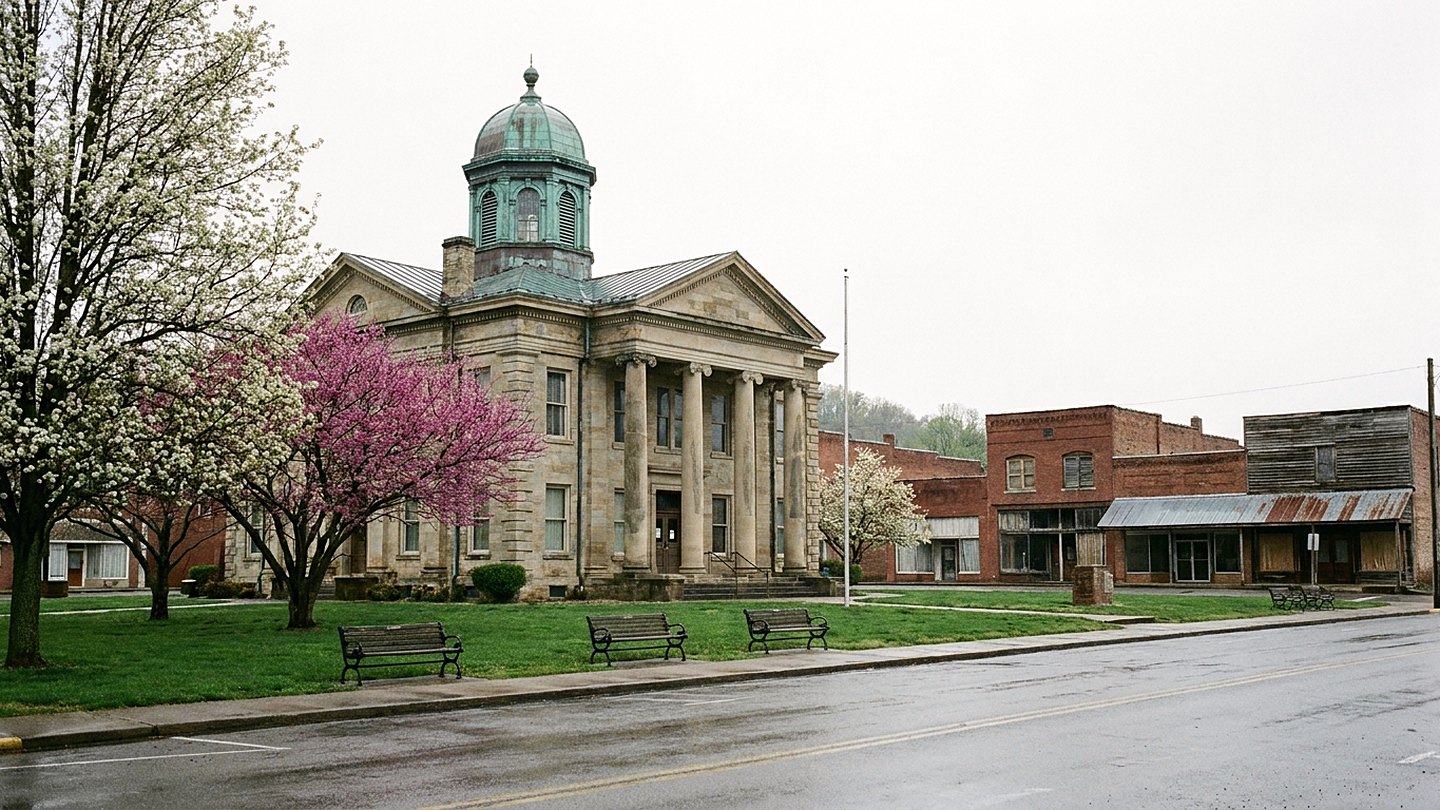
The courthouse is brick, a warm red gone uneven with age, laid in courses that still run straight and true. Stone trim frames the windows and carries across the front in a band at the second floor. The windows are taller than any room needs them to be, and that is exactly what makes an old public building read as public from a hundred feet away. There is a tower at the center with a clock face on it, and the tower is square where my memory had insisted it was not.
The steps up to the doors are stone, three of them, worn in the middle in a way you can feel through a boot sole. Two doors, a plain hood over them, and a lamp on either side that was still lit at eight and had gone dark by nine.
The rest of the square is lawn and walkway. Maples stand near the corners, still bare on the seventh, buds swollen and pink at the tips. Iron frames with wood slats give you somewhere to sit, four of them by my count, and every one faces the building rather than the street. Somebody had set a planter at the foot of the flagpole. A rack for bicycles stood empty the whole hour.
An hour of ordinary noise
I was on the square from eight-oh-four until nine-oh-eight, and the town started up around me in stages.
At ten past the hour a truck came through in low gear, and the sound came off the brick fronts across the street twice, once flat and once softer. That doubling is the thing I kept coming back to. On a square, noise has walls to work with, and it behaves in a way it never does out on an open road.
Between eight and half past, the sidewalk carried a thin, steady traffic of people going to work. Nobody hurried. Two of them stopped at the corner and talked for six or seven minutes, which only happens where the walk is wide enough to stand on without being in the way.
A mower started somewhere behind the block at eight-forty and ran about ten minutes. A dog barked twice from a porch two streets over. Birds worked the bare maples the entire time, and near nine a crow settled on the tower and made itself heard over all of it. Somewhere south of the square a train horn sounded twice, low and long, and then the morning went back to what it had been doing.
What took the time
Since this journal keeps count, here is where the hour actually went.
- Eleven minutes walking the perimeter of the square, once slow, then again slower.
- Thirty-two minutes seated at the northwest corner, looking at the front of the building.
- Nine minutes seated on the far side, where the sun landed first.
- Twelve minutes standing at the corner crossing, mostly listening to traffic.
That comes to sixty-four minutes, and none of it dragged. I had expected an hour of sitting still to feel long. It did not, because a square is never fully still, and because the light kept moving even when nothing else did.
Three things caught me off guard. The first was the sun. At eight-fifty the cloud broke over the east side of the block and the light came down the face of the courthouse in a line I could watch travel, and the brick went from brown to red in about four minutes. The second was how much of the square is built for waiting: every seat faces the doors, which tells you people wait here, and the town laid it out knowing that. The third was that quiet is not the same thing as empty. I counted better than fifty people crossing the square in an hour and it never once felt busy.
What it came to
Sixty-four minutes on the square, seventy-eight miles of driving, and one hour and thirty-two minutes at the wheel with the trip home included. I pulled in just before ten with ten hours of daylight still ahead of me.
It will not suit everyone. Early April gives no shade here at all, since the maples had not leafed out, and by late June I expect the west seats are the only comfortable ones after ten. There are three stone steps at the front doors and no ramp on that face, though the walkway around the lawn is flat and even. If you want a list of things to do, this is not that kind of hour, because the whole method is holding still and letting a place go about its morning. And if road noise bothers you, take the north side of the square, where the buildings knock it down by half.
What I brought home is small, and I would drive it again. A county seat has one square, and the square has one job, which is to be the place everyone walks past. Give it an hour and it stops being a roofline you catch at forty-five miles an hour.
The count
- Time on site 64 minutes
- Driving 78 miles, 1 hour 32 minutes at the wheel
- Daylight left 10 hours, home before ten
Checked against
- Town of Ripley public pages, for street names and the shape of the block
- Jackson County Historical Society pages, read in general terms for background on the square
- National Weather Service forecast for Jackson County, for the morning temperature and the cloud cover

Wes CardwellFounder and editor. Charleston, West Virginia. Every trip on this site was driven, walked, and timed by hand.